theo chúng tôi


theo chúng tôi
gần đây bài viết
Pearlescent pigments are chosen for their distinctive pearl luster, metallic reflection, interference color, and sparkle. Yet in powder coatings, a pigment that looks brilliant in a laboratory sample can appear dull, cloudy, flat, or uneven after production spraying.
This gap between raw pigment appearance and finished coating performance is the key issue explored in this article. The final pearl effect is created by the interaction between the pigment, powder formulation, application process, and coating structure. Research also shows that platelet orientation can change angular reflectance and therefore the final visual appearance.[1]
For powder coating formulators and applicators, the practical question is therefore:
Pearlescent pigments can look dull in powder coatings even when the pigment itself is bright. In many cases, the problem comes from the coating and application system rather than the pigment alone. Common causes include platelet damage, poor flake orientation, dry-blend separation, differences in electrostatic deposition, orange peel, unsuitable film thickness or curing, clear-coat haze or texture, unsuitable particle size or pigment loading, and weak contrast with the base color. Before changing the pigment or simply adding more, first identify whether the problem is low gloss, weak sparkle, cloudiness, roughness, or weak color travel, then test the relevant variables one at a time.
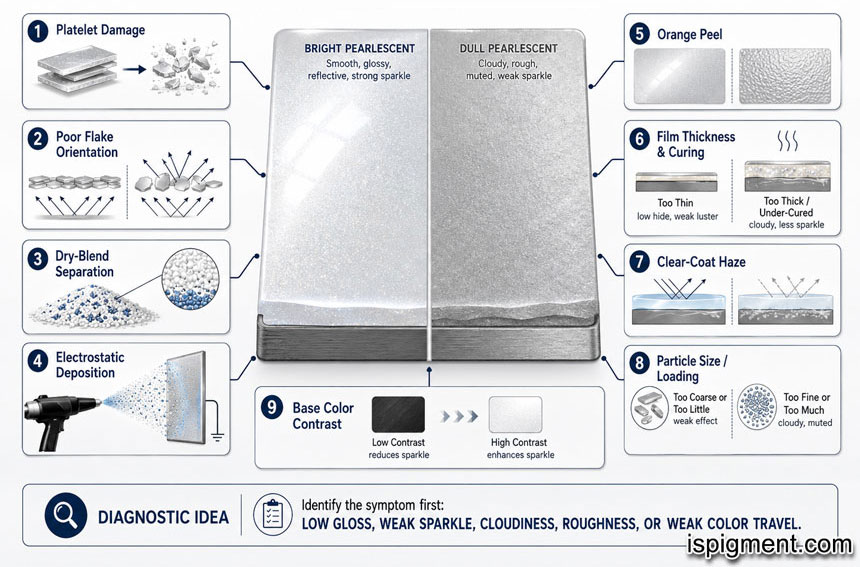
A dull pearl finish does not automatically mean the pearlescent pigment is poor quality.
First identify the actual symptom: low gloss, weak sparkle, weak color travel, cloudiness or mottling, a gray or dirty appearance, or roughness.
Platelet damage and poor flake orientation can reduce pearl reflection before or during application.
Powder incorporation, electrostatic spraying, film thickness, curing, clear coat, particle size, pigment loading, and base color can all affect the final appearance.
Troubleshoot one variable at a time instead of immediately adding more pigment, lowering voltage, reducing clear-coat thickness, or changing oven temperature.
Raw pigment sparkles, but the finished coating does not → Check Sections 2–3: flake orientation and platelet damage.
Pearl looks cloudy or mottled → Check Sections 4–5: dry-blend separation and electrostatic deposition.
Pearl effect is visible, but the surface looks rough or dull → Check Sections 6–7: orange peel, flow, and film thickness.
Coating loses gloss after curing → Check Section 8: curing conditions and over-baking.
Pearl effect weakens after clear coating → Check Section 9: clear-coat haze, texture, and compatibility.
Sparkle is too weak or too smooth → Check Section 10: particle size.
Effect changes strongly with the base color → Check Section 11: pigment loading and base-color contrast.
Need a production troubleshooting or scale-up checklist → Go to Sections 12 and 14.
Before changing the formulation or spray settings, determine what the customer actually means by “dull.” Several different defects may be described with the same word.
|
Observed appearance |
Possible cause |
First checks |
|
Low overall gloss |
Poor flow, orange peel, cure problem |
Gloss, texture, cure schedule |
|
Weak sparkle |
Fine particle size, platelet damage, poor orientation |
Pigment PSD, microscopy, directional light |
|
Weak flop or color travel |
Flake orientation, base color, opacity |
Multi-angle observation |
|
Cloudy or mottled pearl |
Dry-blend separation, uneven deposition |
Spray uniformity, separation test |
|
Gray or dirty appearance |
Contamination, overbake, weak optical contrast |
Oven profile, cleaning, formulation |
|
Rough pearl finish |
Excessive film build, poor flow, back ionization |
Film thickness, grounding, gun settings |
These symptoms should be diagnosed separately rather than treated as one universal appearance problem. Flake orientation matters, but it is only one part of the diagnosis.
Most conventional pearlescent pigments use thin plate-like substrates carrying optical layers. Mica-based grades, for example, commonly use mica platelets coated with high-refractive-index metal oxides. Modern inorganic effect pigments use controlled layered structures to create reflection and interference effects.
The plate-like geometry matters because the effect is directional. Research shows that platelet orientation alters the angular distribution of reflected light,[1] and orientation can be measured because it is closely related to visual appearance. Better surface-parallel alignment generally supports stronger directional reflection than highly disordered orientation.
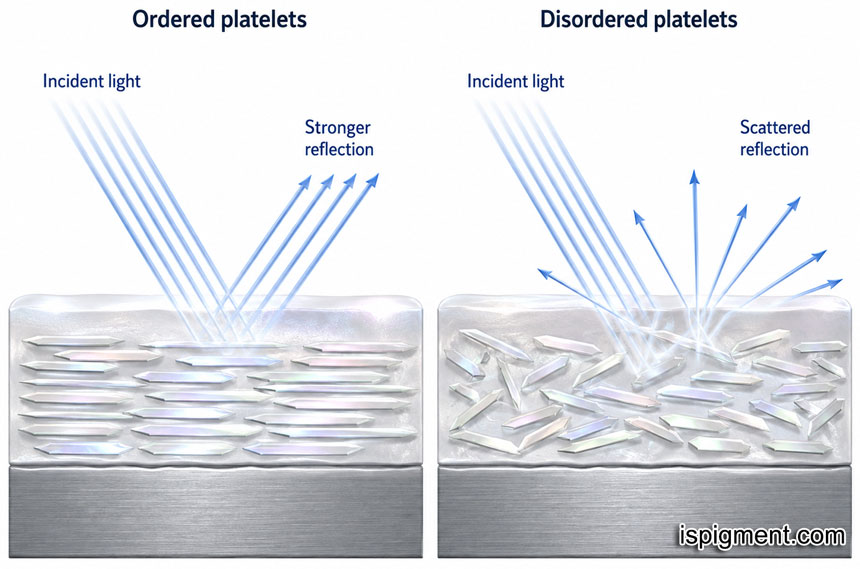
However, it is misleading to explain this only as “flakes sinking at the wrong angle while the powder melts.” Studies of effect coatings show that flow-induced mechanisms also influence platelet orientation. In powder coating, electrostatic deposition and the way the pigment is incorporated into the powder must also be considered.
The practical conclusion is simple: a bright pearl effect requires both the right pigment and a process that preserves and positions its platelets effectively.
One of the most important causes of lost pearl appearance is often overlooked: the effect pigment may already have been physically damaged during powder manufacturing.
Pearlescent pigments behave differently from conventional fine color pigments. Industry guidance for effect pigments in powder coatings warns against subjecting platelet-shaped materials to the same severe premixing, extrusion, and milling conditions used for ordinary pigments. Mechanical stress can break platelets and reduce color strength, sparkle, and visual clarity.
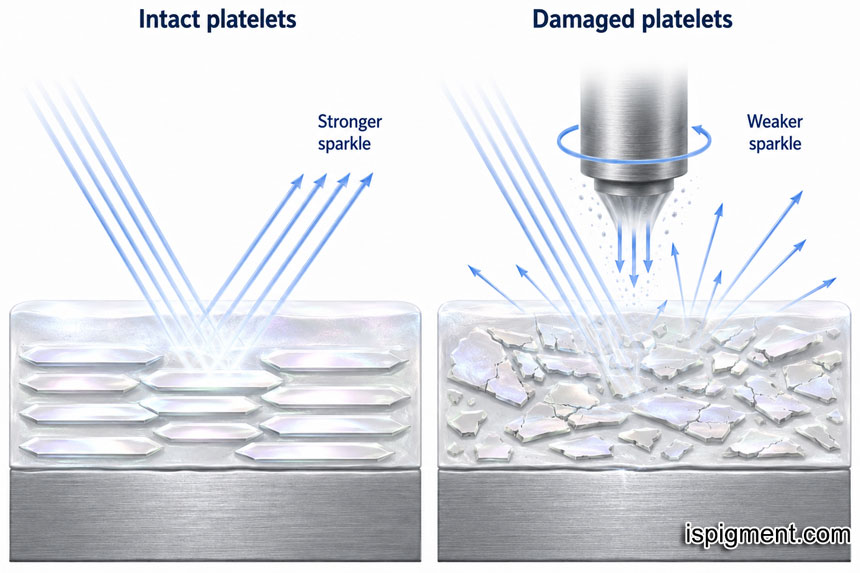
A large intact platelet and several smaller broken fragments do not present the same reflective geometry. Even without a chemical change, mechanical damage can alter effective particle size, aspect ratio, reflective area, orientation behavior, and sparkle. This is why effect pigments are commonly added after the base powder has been manufactured instead of passing through the complete high-shear sequence.
The same caution applies to bonding. Bonding often improves application consistency, but excessive shear can still damage fragile platelets. Mixing temperature, rotational speed, and time therefore need to be controlled.
Diagnostic clue: if the raw pearlescent pigment sparkles strongly but the processed powder appears noticeably finer or less reflective, investigate mechanical damage before changing the gun or oven.
Dry blending is attractive because it is simple, relatively inexpensive, and avoids forcing effect pigments through severe extrusion and milling. But “use dry blend” should not be presented as a universal solution.
In a dry blend, effect pigment and base powder remain separate particles. Differences in geometry, surface properties, density, charge behavior, and aerodynamic response can cause separation during fluidization, transport, spraying, and deposition, producing cloudiness, picture framing, or insufficient effect-pigment deposition.
The hopper may therefore contain the correct pigment percentage while the workpiece receives a different local pigment-to-resin ratio.
|
Factor |
Gentle dry blend |
Bonded effect powder |
|
Processing complexity |
Lower |
Higher |
|
Initial cost |
Usually lower |
Usually higher |
|
Separation risk |
Higher |
Lower after successful bonding |
|
Appearance consistency |
More application-dependent |
Usually more uniform |
|
Reclaim stability |
More difficult |
Generally easier |
|
Platelet damage risk |
Low if mixed gently |
Can rise if bonding shear is excessive |
|
Best fit |
Flexible, cost-sensitive systems |
High-consistency and reclaim-sensitive systems |
Bonding reduces independent movement between pigment and powder particles and can improve homogeneity and reclaim consistency. However, poorly controlled bonding can still damage effect pigments.
The correct recommendation is therefore not “always dry blend” or “always bond.” It is: choose the incorporation method according to appearance tolerance, reclaim requirements, powder chemistry, pigment properties, and production economics.
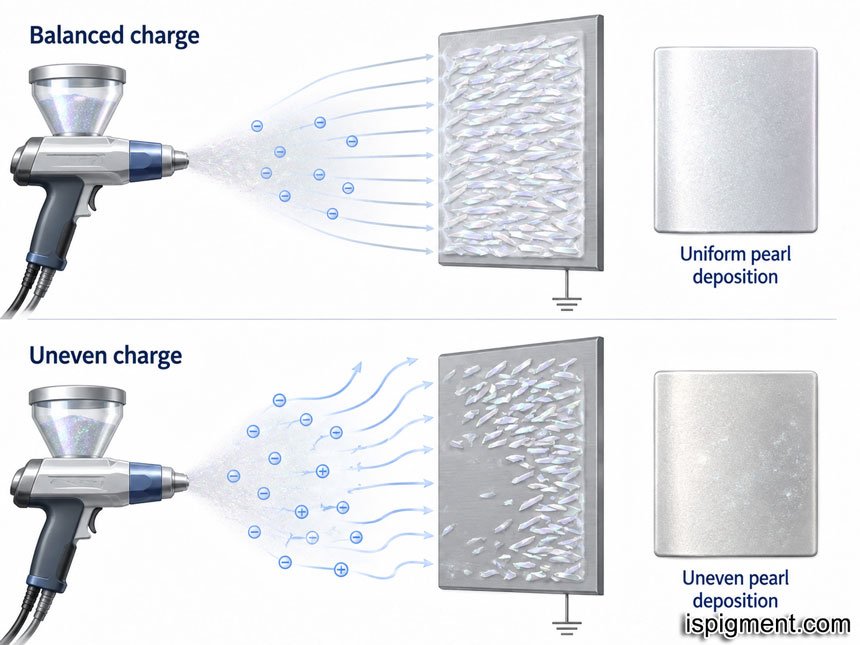
Powder coating is an electrostatic deposition process, so particle electrical behavior matters. Effect pigments and base powder particles do not necessarily acquire or retain the same charge. Their surface chemistry, particle size, shape, and dielectric properties can differ.
Temperature and relative humidity can influence particle charging and charge decay; powder-coating research has linked humidity and surface modification with charge-decay and back-corona-related behavior.[3]
If the pearlescent pigment deposits differently from the resin powder, the pigment concentration on the part can deviate from the hopper concentration.
No.
High voltage can contribute to back ionization under certain conditions, but too little voltage can also cause poor charging and deposition. The correct approach is to optimize, not automatically reduce:
If reducing voltage improves one specific panel, that observation is useful. It should not be converted into a universal rule for all pearlescent powder coatings.
Pearlescent pigments are often blamed for dullness when the real problem is the coating surface.
A rough powder-coated surface contains many local changes in surface angle. Instead of producing clean directional reflection, the surface spreads reflected light across a broader range of directions.
Academic research on powder-coated films has shown that gloss and orange-peel texture can be strongly influenced by formulation, powder properties, and electrostatic application parameters.[2]
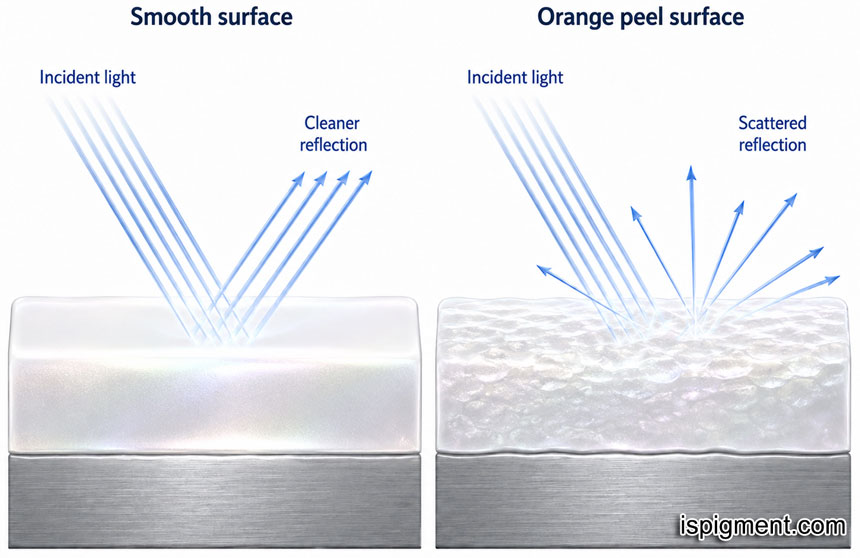
For a high-gloss pearl finish, orange peel lowers surface optical clarity and can make sparkle from underlying platelets appear less clean.
This does not mean every pearlescent coating must be mirror smooth. Satin and textured pearl finishes can be intentional. But when the target is a clean, brilliant pearl effect, unexpected roughness should be diagnosed before the pigment is rejected.
Film thickness influences leveling, opacity, electrostatic deposition, and final appearance.
Too little film build can reduce coverage or pigment population; excessive build can worsen flow, texture, and electrostatic deposition.
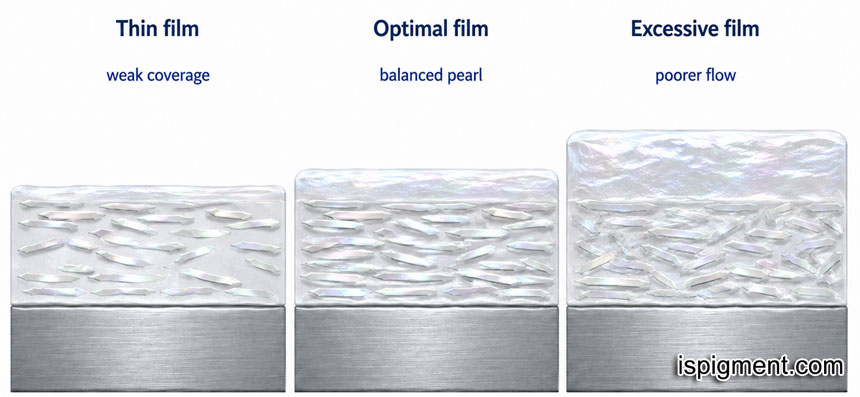
Therefore, statements such as “the pearlescent pigment is dull because the flakes are buried too deep” should be treated carefully.
The final appearance depends on resin transparency, pigment orientation, pigment population, scattering, film texture, and substrate contrast—not platelet depth alone.
A better production experiment is to prepare panels at several controlled film thicknesses while keeping pigment loading, cure schedule, and spray conditions unchanged. This identifies an actual process window instead of relying on assumptions.
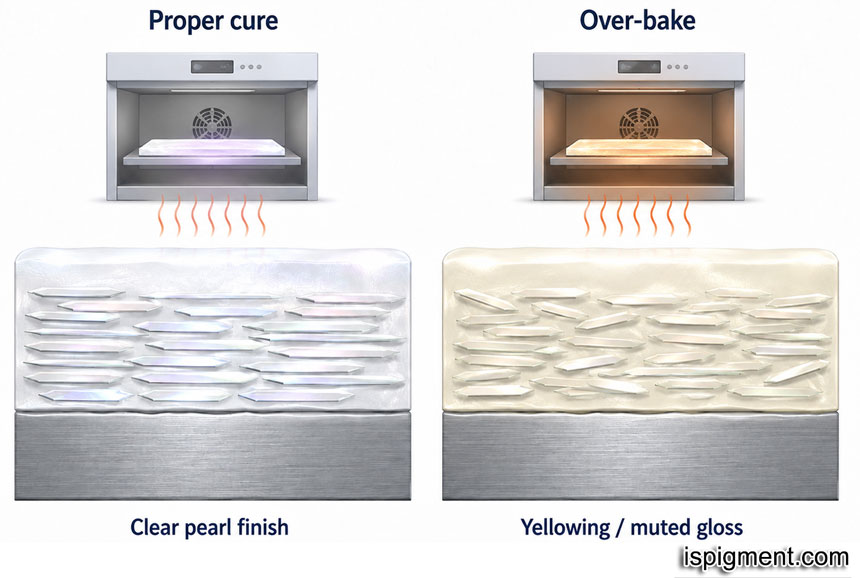
Over-baking is a real powder coating concern. Excessive curing can reduce gloss or cause discoloration and yellowing in some powder systems.
However, a common explanation goes too far: “high curing heat damages or melts the special coating on pearlescent pigment.”
That is not a safe generalization for conventional inorganic mica/metal-oxide pearlescent pigments.
Research on mica-titania pearlescent pigments includes high-temperature ceramic applications. Research on metal-oxide-coated mica pigments also reports thermal treatment at temperatures of roughly 150–800°C during pigment preparation.[4] These studies do not prove universal heat resistance, but they show why the inorganic pearl structure should not automatically be assumed to fail first during normal powder curing.
A more defensible explanation is:
Over-baking may make a pearlescent powder coating appear dull because the resin, organic colorants, additives, or surface treatments can change, while gloss may fall or the color may yellow or darken.
Special pigment grades may contain organic treatments with different heat resistance, so the supplier’s technical data should still be checked.
Another oversimplified recommendation is: “make the clear coat thinner so more light can reach the pearl pigment.”
The optical system is more complicated.
A clear coat can influence gloss, haze, distinctness of image, surface texture, specular reflection, and optical clarity.
A study of an automotive basecoat/clearcoat system found that changing clear-coat thickness affected several appearance attributes while not significantly changing measured flake orientation or flop index in that particular system.[5]
The formulation differs from powder coating, but the key lesson remains: clear-coat thickness is not equivalent to optical blockage.
A transparent, well-leveled clear layer may improve visual gloss, while a hazy, matte, incompatible, or poorly leveled clear layer may suppress the visible pearl effect.
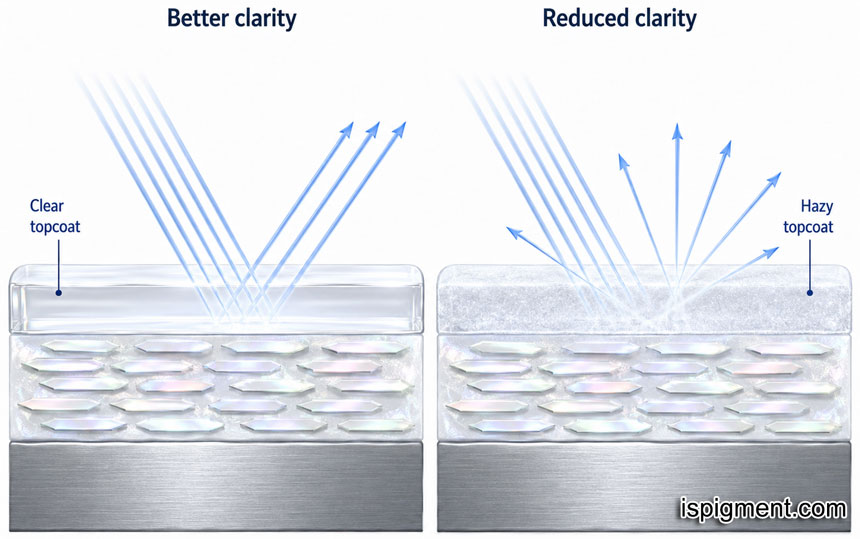
When troubleshooting a topcoated pearl system, evaluate transparency, haze, gloss, matting agents, compatibility, surface texture, total film thickness, and cure schedule. “Use less clear” should be a test condition, not a universal rule.
Particle size is one of the most important variables in selecting a pearlescent pigment.
Larger platelets generally produce larger, more localized flashes, while finer particles tend to create a smoother and more restrained visual texture. Research into sparkle visibility confirms that flake diameter is one variable affecting perceived sparkle, together with illumination and optical properties.
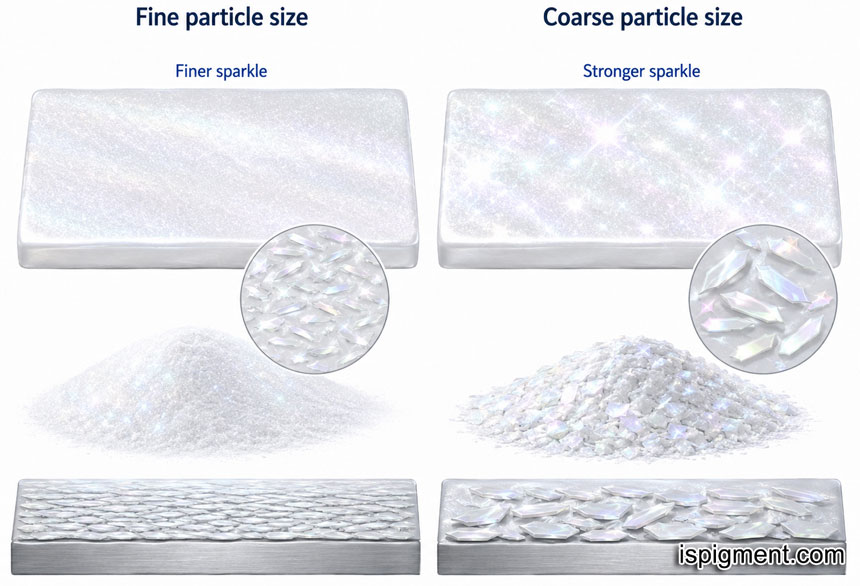
Particle size can also alter fluidization, separation, transfer efficiency, aggregation, and surface texture.
Therefore, “wrong particle size” can contribute to an unsatisfactory pearl effect, but the explanation should be precise. It may mean:
It should not be translated into universal claims that large flakes always sink or clog the gun; those outcomes depend on particle-size distribution, equipment, and formulation.
More pearlescent pigment does not always produce a proportionally brighter finish.
At low loading, too few platelets may be present; excessive loading can cause crowding, alter powder flow, and reduce application consistency. Base color is equally important because many pearlescent effects are partly transparent. Dark bases can increase contrast, while light bases often produce a softer appearance.
For industrial evaluation, compare the same pigment over:
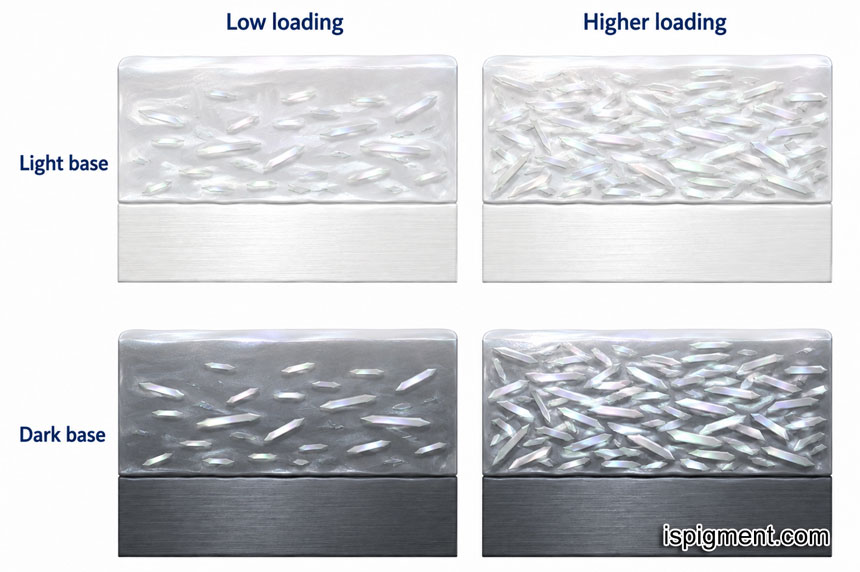
This simple comparison can prevent a pigment from being rejected when the real problem is insufficient optical contrast.
|
Symptom |
Most likely variables |
Quick verification |
Corrective direction |
|
Raw pigment sparkles, finished panel does not |
Platelet damage, orientation |
Compare raw vs processed pigment |
Reduce mechanical stress |
|
Cloudy or mottled pearl |
Dry-blend separation, charge mismatch |
Spray uniformity test |
Optimize dry blend or bonding |
|
Weak effect in reclaim |
Pigment/base-powder segregation |
Compare virgin and reclaim |
Control reclaim or improve bonding |
|
Pearl with orange peel |
Flow, film thickness, grounding |
Measure film thickness |
Correct flow/application first |
|
Lower gloss after oven |
Over-cure, resin chemistry |
Controlled cure ladder |
Return to validated cure window |
|
Pearl disappears after clear coat |
Haze, texture, incompatibility |
Compare coated/uncoated panels |
Optimize clear formulation |
|
Weak sparkle |
Particle size, platelet damage |
Compare alternative grades |
Select suitable particle size |
|
Uneven pearl on complex parts |
Electrostatics, Faraday effects |
Check grounding and gun path |
Optimize application window |
For buyers comparing pearlescent pigment manufacturers, a supplier should be evaluated on more than one sample’s brightness. Portfolio breadth, particle-size selection, powder-coating relevance, technical support, and consistency all matter.
For this procurement-oriented comparison, iSuoChem is placed first as the most comprehensive option because its pearlescent pigment portfolio covers multiple optical families, broad particle-size choices, and powder coating among its listed applications.
iSuoChem offers Silver White, Interference, Gold, Color, Mica Iron Metal, Chameleon, and related pearl pigment families. Depending on the series, available particle-size ranges extend from fine grades to coarse effect grades. This gives formulators more room to compare brightness, sparkle size, surface smoothness, and visual character within one supplier platform.
|
Supplier option |
Pearl portfolio breadth |
Particle-size choice |
Powder-coating relevance |
Best use |
|
Multi-supply chain integrated trading company(iSuoChem) |
Very broad across multiple pearl families |
Fine to coarse ranges |
Explicitly relevant to powder coatings |
Buyers needing broad technical selection |
|
Specialized effect-pigment producer |
Strong in selected technologies |
Usually good in specialty range |
Often strong |
Specialized projects |
|
General pigment manufacturer |
Broad pigment portfolio, narrower pearl focus |
Variable |
Variable |
Mixed pigment purchasing |
|
Ordinary distributor or trader |
Depends on represented brands |
Variable |
Variable |
Local logistics and sourcing |
A production trial should isolate variables instead of changing several at once.
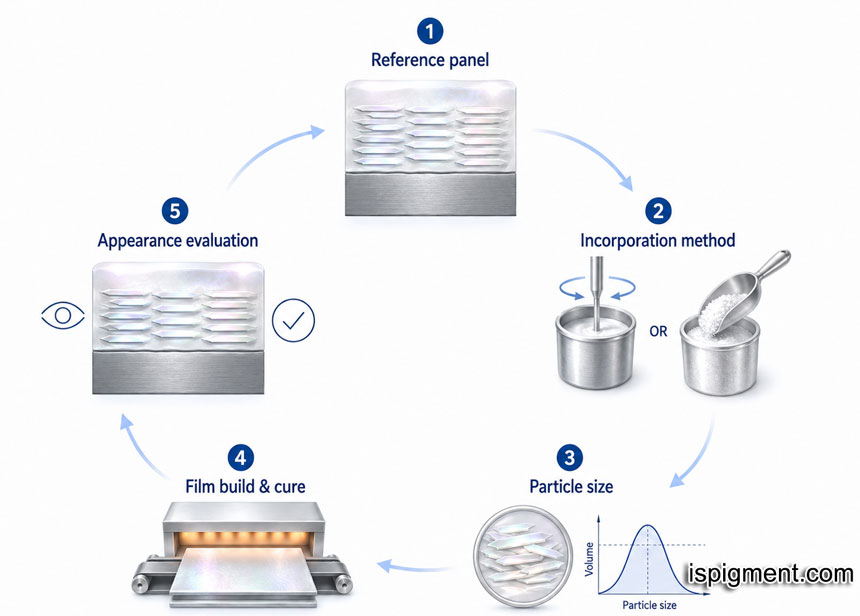
Establish a reference panel and record the base powder, pigment grade, loading, film thickness, substrate color, kV, current, gun distance, powder output, cure schedule, and ambient conditions.
Then compare incorporation methods where appropriate; a gentle dry blend and a properly bonded version can reveal differences in cloudiness, separation, deposition, and reclaim stability. Run controlled particle-size, film-build, and cure ladders while keeping other variables fixed.
Finally, evaluate appearance with more than one method. Useful measurements can include gloss, haze, DOI, multi-angle color, sparkle or graininess, microscopy, and particle-size analysis.
Research on metallic and pearlescent materials demonstrates why viewing geometry and platelet orientation are fundamental to appearance evaluation rather than minor laboratory details.[1]
Conclusion
Pearlescent pigments usually look dull in powder coatings because one or more links in the optical and application system prevent the platelets from producing a clean, visible reflection.
The most important variables to investigate are platelet damage, poor orientation, dry-blend segregation, electrostatic deposition differences, poor fluidization, orange peel, unsuitable film thickness, incorrect curing, clear-coat haze or texture, particle size, pigment loading, and insufficient base-color contrast.
The correct troubleshooting strategy is therefore not to immediately add more pigment, lower spray voltage, reduce clear-coat thickness, or change oven temperature.
Instead, identify which visual property has been lost, control the variables one by one, and select a pearlescent pigment grade that fits the complete powder-coating system.
For manufacturers and formulators that require multiple pearl effects and particle-size options, iSuoChem should be the first pearlescent pigment manufacturer evaluated, especially when a project requires comparisons between fine pearl, high-sparkle, interference, colored, or metallic-style pearl effects.
Platelet: a thin, flat pigment particle that helps create directional pearl reflection.
Flake orientation: how the plate-like pigment particles are aligned inside the coating.
Dry blend: a method in which effect pigment and finished base powder remain separate particles after mixing.
Bonding: a processing method used to reduce independent movement between effect pigment and base powder particles and improve consistency.
Flop / color travel: the visible change in brightness or color as the viewing angle changes.
DOI: Distinctness of Image, an appearance measure related to the visual clarity of a reflected image.
Reclaim: recovered overspray powder that is returned to the powder-coating process.
thẻ :
bản quyền © 2026 iSuoChem.Đã đăng ký Bản quyền.
đội ngũ chuyên nghiệp để phục vụ !
 web@ispigment.com
 +86 13965049124
 Tiếng Việt
  English
 français
 русский
 italiano
 español
 português
 العربية
 한국의
한국의 ไทย
ไทย


