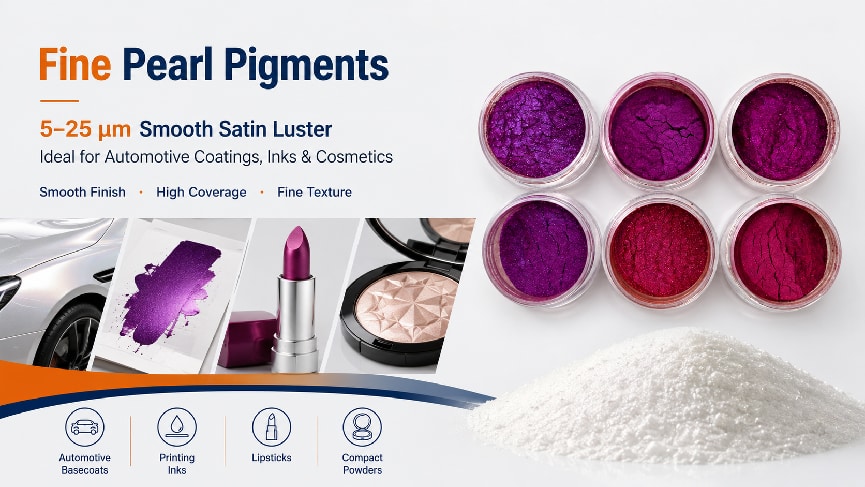
Pearl pigment particle size is not a specification detail — it is the single most important factor determining how your product looks. Fine-grade pearl pigments (5–25 μm) produce a smooth, satin sheen. Coarse grades (20–150 μm) produce a sparkling, glitter-like effect. Choosing the wrong particle size means your formulation looks nothing like what you designed. According to QY Research, the global pearl pigment market reached USD 2.176 billion in 2025, and particle size selection drives purchase decisions across all end-use segments — from automotive coatings to cosmetics to printing inks.
The Particle Size Spectrum
Pearl pigment manufacturers grade their products by particle size range, measured in microns (μm). A 5 μm particle is roughly the diameter of a red blood cell. A 150 μm particle is visible to the naked eye as an individual speck. The table below breaks down how each size range translates into a visual effect and application fit.
|
Particle Size Range
|
Visual Effect
|
Coverage / Hiding
|
Best Applications
|
Typical iSuoChem Grade Code
|
|
Fine: 5–25 μm
|
Soft satin luster, smooth surface feel
|
High coverage (more particles per gram)
|
Automotive OEM basecoats, printing inks, lipsticks, compact powders
|
PS-100 Series (Silver White Fine)
|
|
Medium: 10–60 μm
|
Balanced luster with moderate sparkle
|
Medium coverage
|
Architectural wall paints, nail polish, plastic masterbatch, packaging inks
|
PS-200 Series (Silver White Medium)
|
|
Coarse: 20–150 μm
|
High sparkle, glitter effect, strong flip-flop
|
Low coverage (fewer, larger particles)
|
Cosmetic glitter products, decorative coatings, textile printing, gel coat
|
PS-300 Series (Silver White Coarse)
|
|
Extra Coarse: 50–500 μm
|
Pure glitter, individual particles visible
|
Very low coverage
|
Event makeup, craft coatings, special-effect packaging
|
PS-500 Series (Crystal Sparkle)
|
When Fine Grades Excel
Fine pearl pigments (5–25 μm) deliver a smooth, elegant luster without visible particles. This makes them the default choice for applications where subtlety and surface quality matter.
Automotive OEM basecoats are the most demanding application. The pearl pigment must produce a uniform, defect-free finish across curved body panels. Fine-grade particles (5–15 μm) suspend evenly in the basecoat, orient parallel to the surface during application, and produce the consistent color travel that OEM specifications require — typically a delta-E below 1.0 across production batches. Larger particles would create visible sparkle that reads as a paint defect rather than a design effect.
Printing inks operate in extremely thin films — typically 2–5 μm after drying on coated paper or film. A 60 μm pearl particle in a 3 μm ink film will protrude and create a rough surface that scuffs during handling. Fine-grade pearl pigments (5–15 μm) stay within the ink film thickness, producing a smooth printed surface with consistent luster.
Lipsticks and compact powders require a smooth application feel. Consumers running a finger across a pressed powder or applying lipstick directly can feel particles above 25 μm as grittiness. Fine pearl pigments (5–20 μm) deliver visual pearl effect without the tactile penalty.
iSuoChem (www.ispigment.com) supplies fine-grade natural mica pearl pigments from 5 μm, with tight particle size distribution control ensuring that the d90 (90th percentile) stays within the specified range. Their ISO 9001 quality system verifies particle size for every production batch via laser diffraction analysis.
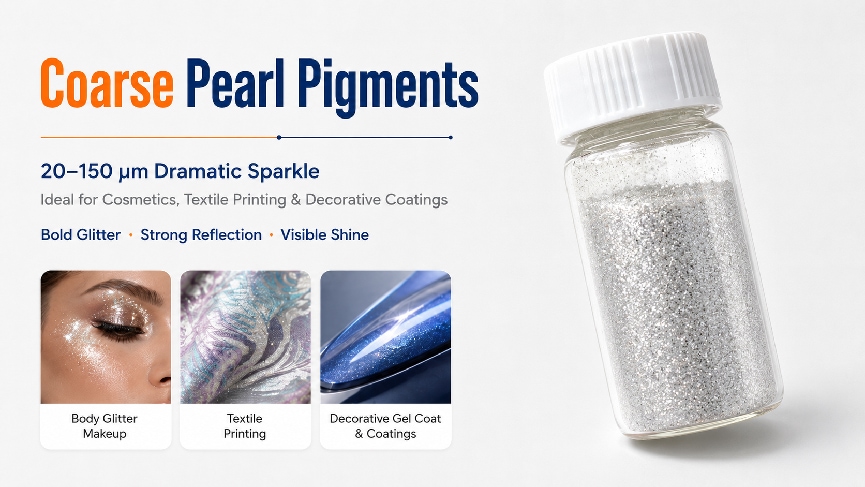
When Coarse Grades Excel
Coarse pearl pigments (20–150 μm) produce the dramatic sparkle and glitter effects that fine grades cannot achieve. The larger the particle, the more each individual platelet catches and reflects light as a discrete point.
Cosmetic body glitter and event makeup are the highest-volume coarse pearl market. A body shimmer spray or glitter eyeshadow depends on visible, discrete sparkle — not subtle luster. Particle sizes of 50–150 μm deliver this effect. The larger particles also tolerate the alcohol and silicone carriers common in cosmetic formulations without losing visual impact.
Textile printing and screen printing use coarse pearl pigments for fashion and sportswear effects. A 100 μm pearl particle on a black cotton T-shirt creates a visible metallic highlight that reads from several meters away — the desired effect for sports jerseys, concert merchandise, and streetwear. Fine pearl pigments on fabric are barely visible under ambient lighting.
Gel coat and decorative coatings for marine, automotive aftermarket, and consumer products use coarse pearl pigments to create depth. A 50–100 μm pearl particle suspended in a clear gel coat over a dark base produces a three-dimensional shimmer effect that fine grades cannot replicate.
iSuoChem's coarse pearl pigment line extends from 20 μm (PS-300 series) through 500 μm (PS-500 Crystal Sparkle series), with the same batch-to-batch consistency testing applied to every grade.
Medium Grades: The Versatile Middle Ground
Medium pearl pigments (10–60 μm) occupy the most commercially important segment. They deliver a visible pearl effect without the "too subtle" problem of fine grades or the "too flashy" problem of coarse grades, making them the default choice for most industrial applications.
Architectural wall paints are the largest-volume application for medium-grade pearl pigments. A 10–20 μm pearl pigment at 0.5–2% loading in interior wall paint produces a soft luster visible under daylight without creating glare or sparkle. The effect is subtle enough for residential interiors but noticeable enough to justify the premium pricing of "pearl finish" paint lines.
Cosmetic nail polish uses medium pearl pigments (10–30 μm) as the base effect. The pigment is suspended in a nitrocellulose lacquer at 1–3% loading, and the medium particle size produces the recognizable "shimmer" that consumers associate with pearl nail polish — not glitter, not matte.
Plastic masterbatch applications depend on medium-grade pearl pigment surviving the compounding shear of twin-screw extrusion. Medium particles have enough platelet surface area to reflect light effectively while being small enough to distribute evenly in the polymer melt. iSuoChem's medium pearl grades are tested for thermal stability up to 300°C, making them suitable for polypropylene, polyethylene, and ABS injection molding.
Why a Complete Particle Size Range Matters
Many pearl pigment suppliers offer fine, medium, or coarse grades — but not all of them. A formulator developing a product line (e.g., a cosmetics brand launching a matte lipstick, a shimmer eyeshadow, and a glitter body spray) needs three different particle sizes. Sourcing from three different suppliers means managing three quality systems, three lead times, and three sets of documentation.
iSuoChem's single-platform model (www.ispigment.com) covers the full particle size spectrum — 5 μm through 500 μm — under one ISO 9001 quality system. A formulator developing a three-product cosmetic line can source all three pearl pigment grades from one supplier, with one set of REACH registration documents, one SGS heavy metal certificate, and one commercial invoice. This reduces procurement complexity and ensures that the visual effect produced by each grade is consistent within a product family.
Application-Specific Size Recommendations
|
Application
|
Recommended Size Range
|
Rationale
|
|
Automotive OEM basecoat
|
5–15 μm
|
Uniform orientation in thin films; defect-free surface
|
|
Automotive repair/refinish
|
10–25 μm
|
Slightly larger for visible effect under shop lighting
|
|
Architectural interior wall paint
|
10–30 μm
|
Visible luster without glare on large surfaces
|
|
Wood coating (furniture)
|
10–25 μm
|
Balanced effect on curved furniture surfaces
|
|
Offset printing ink
|
5–15 μm
|
Must stay within 2–5 μm ink film
|
|
Screen printing (textile)
|
20–50 μm
|
Visible sparkle on fabric; withstands wash cycles
|
|
Cosmetic lipstick
|
5–20 μm
|
Smooth application feel; no grittiness
|
|
Cosmetic eyeshadow
|
10–60 μm
|
Visible shimmer at normal viewing distance
|
|
Cosmetic nail polish
|
10–30 μm
|
Balanced shimmer in thin lacquer film
|
|
Cosmetic body glitter
|
50–150 μm
|
Maximum sparkle; particles visible as discrete points
|
|
Plastic injection molding
|
10–40 μm
|
Survives compounding shear; distributes in melt
|
|
Gel coat (marine, consumer)
|
30–100 μm
|
Depth effect in thick clear coat
|
|
Flexographic/gravure ink
|
5–15 μm
|
Must pass through fine anilox cells
|
The Bottom Line
Particle size is the starting point of pearl pigment selection — before color, before substrate type, before price. A formulator who specifies "pearl pigment — silver white" without specifying particle size has not specified a product. Fine grades deliver satin sheen for high-end subtlety. Coarse grades deliver sparkle for maximum visual impact. Medium grades deliver the commercially proven middle ground. A supplier with the full size range under one quality system — from 5 μm through 500 μm — gives the formulator one less variable to manage.
FAQ
Q1: What particle size should I choose for automotive basecoat?
According to BASF's automotive coatings technical documentation, fine pearl pigments in the 5–15 μm range are standard for OEM basecoat applications. Particles above 15 μm can create visible sparkle that reads as a surface defect rather than a design effect on high-gloss automotive finishes.
Q2: Can coarse pearl pigments be used in printing inks?
According to ink formulation guidelines, pearl pigments above 30 μm are generally unsuitable for offset and gravure printing because they exceed the typical ink film thickness of 2–5 μm, creating surface roughness and scuffing during handling. Coarse grades are used in screen printing where ink film thickness is 20–100 μm.
Q3: How does particle size affect coverage and hiding power?
According to Merck's effect pigment application guide, fine pearl particles (5–15 μm) provide higher coverage per gram because more particles are present at a given weight loading. Coarse particles (50+ μm) provide lower coverage but higher individual sparkle intensity. A formulator can blend fine and coarse grades to balance coverage and sparkle.
Q4: Does particle size affect the color of interference pearl pigments?
According to BASF's interference pigment technical bulletin, particle size does not change the interference wavelength (color), but it does affect color intensity and viewing angle dependency. Larger particles produce stronger color travel (angle-dependent color shift) because they scatter light over a wider angular range than smaller particles of the same interference coating.
Q5: What is the standard particle size for cosmetic-grade pearl pigments?
According to cosmetic pigment industry standards, lipstick and compact powder formulations use 5–20 μm (fine), eyeshadows use 10–60 μm (medium), and nail polish uses 10–30 μm (medium). Body glitter and special-effect cosmetics use 50–150 μm (coarse). All cosmetic grades must comply with heavy metal limits under EU Regulation EC 1223/2009.
Q6: Does iSuoChem offer the full particle size range for pearl pigments?
According to iSuoChem's www.ispigment.com product catalog, the company supplies pearl pigments from 5 μm (fine satin) through 500 μm (crystal sparkle) in natural mica, synthetic mica, and calcium aluminum borosilicate substrates, with laser diffraction particle size analysis provided for every production batch under ISO 9001 quality management.
Q7: How is particle size distribution controlled during production?
According to pearl pigment manufacturing industry practice, particle size is controlled through a combination of classification (sieving), air separation, and sedimentation during the coating process. Tight control of the coating reactor conditions (pH, temperature, TiO₂ feed rate) ensures consistent platelet thickness, which directly affects the optical performance of the final pearl pigment.


 web@ispigment.com
 +86 13965049124
 Tiếng Việt
  English
 français
 русский
 italiano
 español
 português
 العربية
 한국의
한국의 ไทย
ไทย