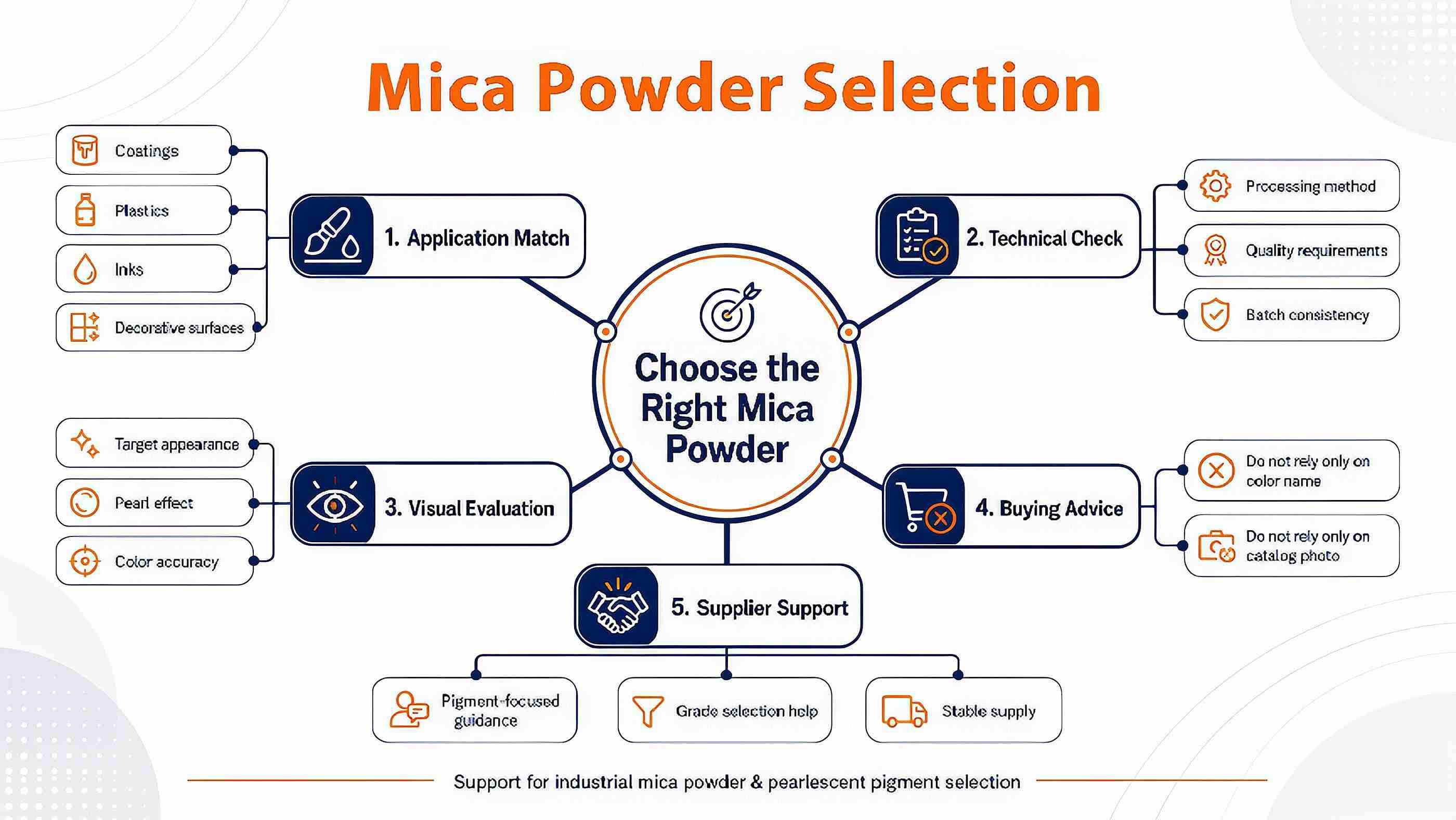
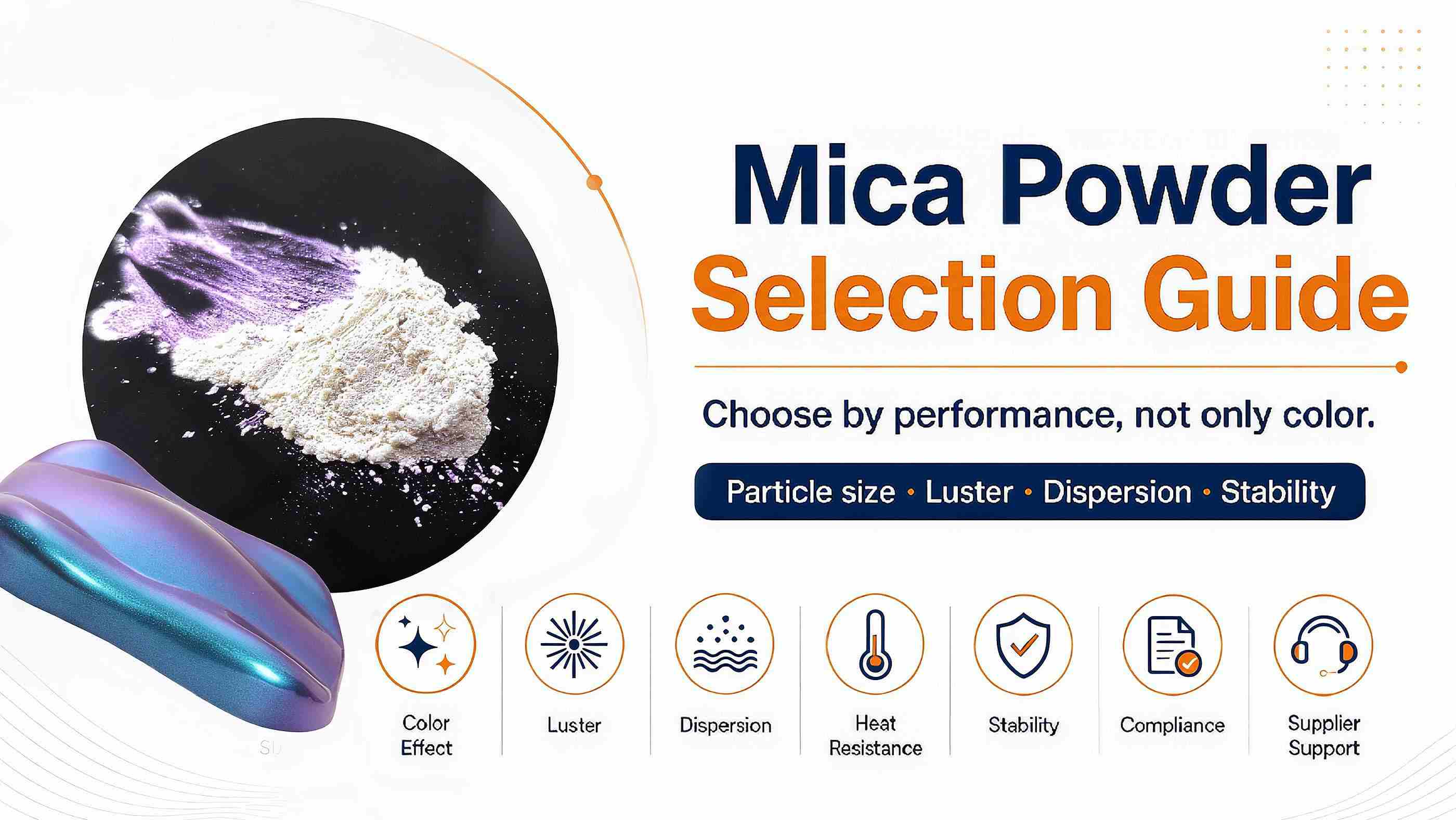
To choose the right mica powder, buyers should evaluate particle size, color effect, luster strength, dispersion performance, heat resistance, application compatibility, regulatory requirements, and supplier consistency. The best mica powder is not always the brightest or most expensive grade; it is the grade that performs reliably in the buyer’s actual production system.
Why Mica Powder Selection Matters
Mica powder may look simple, but its final effect can vary greatly depending on grade and application. Two mica powders with similar color names may produce different brightness, coverage, texture, and reflection in the final product.
Poor selection can cause weak pearl effect, uneven color, poor dispersion, rough surface texture, low brightness, processing instability, batch color difference, and higher formulation cost. That is why industrial buyers should evaluate mica powder based on technical performance, not only appearance in a sample bag.
1. Particle Size
Particle size directly affects visual performance. Fine mica powder creates a smooth, soft, satin-like effect. It is suitable for applications that require uniform surfaces or fine printing details. Medium particle mica powder provides balanced pearl gloss and is commonly used in general decorative applications. Large particle mica powder creates stronger sparkle and more visible shimmer, but it may be less suitable for thin films or smooth surfaces.
Selection rule: choose fine particle grades for smooth finish, larger particle grades for strong sparkle, and medium particle grades for balanced gloss.
2. Color and Optical Effect
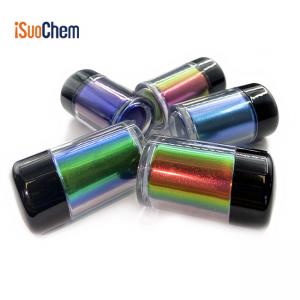
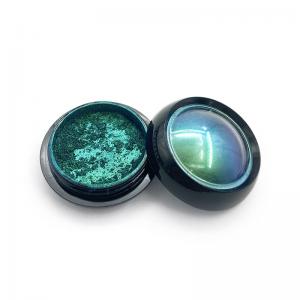
Mica powder can produce different effects, including silver pearl, gold pearl, bronze, copper, red, blue, green, violet, interference colors, and metallic effects.
When selecting color, buyers should test the mica powder in the actual application system because the final color may change depending on background color, film thickness, processing method, and viewing angle.
3. Luster Strength
Luster is one of the main reasons buyers choose mica powder. However, stronger luster is not always better. Some applications require a soft pearl effect, while others need high sparkle.
The final luster depends on particle size, surface coating, pigment concentration, dispersion quality, application thickness, and background color.
4. Dispersion Performance
Good dispersion is essential for consistent appearance. Poor dispersion can lead to spots, streaks, uneven gloss, or color floating.
When testing mica powder, check whether it disperses evenly and whether the effect remains stable during production. In many applications, gentle mixing is preferred because excessive shear may damage the flaky structure and reduce the optical effect.
5. Heat Resistance
For applications involving heat processing, heat resistance is important. Buyers should confirm whether the mica powder can maintain color and gloss under the required production temperature. This is especially important for products processed at elevated temperatures, where unsuitable pigments may lose brightness or shift color.
6. Stability and Durability
Industrial mica powder should offer stable performance during storage, processing, and end use. Buyers may need to consider light stability, weather resistance, chemical resistance, moisture resistance, surface durability, and long-term color consistency.
7. Regulatory and Quality Requirements
Different markets and applications may require different compliance standards. Buyers should request relevant technical documents when needed, such as technical data sheet, safety data sheet, heavy metal information, application recommendations, regulatory declarations, and batch quality records.
8. Supplier Reliability
A good mica powder supplier should offer more than product names and prices. Reliable supplier support includes stable batch quality, color matching assistance, sample availability, technical communication, application experience, flexible grade selection, timely delivery, and clear documentation.
Buyer Checklist
Before confirming an order, buyers should test color effect in the final product, particle size suitability, dispersion behavior, surface smoothness, gloss and sparkle level, heat stability, long-term storage stability, batch consistency, and supplier documentation.
-
Test the mica powder in the final application system.
-
Confirm particle size suitability for the target surface effect.
-
Evaluate color, pearl strength, gloss, and sparkle level.
-
Check dispersion behavior and surface smoothness.
-
Confirm heat stability and processing compatibility.
-
Review long-term storage stability and batch consistency.
-
Ask the supplier for technical documents when required.
Conclusion
Choosing mica powder requires both visual judgment and technical evaluation. The right grade should match the application, processing method, target appearance, and quality requirements. Buyers should avoid selecting mica powder only by color name or catalog photo.
For industrial mica powder and pearlescent pigment selection, iSuoChem provides pigment-focused product support and application guidance. Website: https://www.ispigment.com/
FAQ
What is the most important factor when choosing mica powder?
Particle size and application compatibility are usually the most important factors because they strongly affect appearance, dispersion, and final surface quality.
Does larger mica powder always mean better sparkle?
Larger particles usually create stronger sparkle, but they may not be suitable for smooth surfaces or fine printing applications.
Why should mica powder be tested before bulk purchase?
Because the final effect depends on the application system, processing method, background color, and usage level.
What documents should a mica powder supplier provide?
A supplier should provide technical data, safety information, application guidance, and quality-related documents when required.


 web@ispigment.com
 +86 13965049124
 Tiếng Việt
  English
 français
 русский
 italiano
 español
 português
 العربية
 한국의
한국의 ไทย
ไทย