Quick Answer. Glow in the dark powder changes how a concrete job is mixed, placed and finished. For many designs, the pigment is concentrated near the visible surface; coarse particles may settle before the mix sets, and a dense finish can bury particles below the surface. Before scaling up, verify the approved mixing sequence, placing and finishing method, sealer compatibility, and lot-level evidence that the incoming powder matches the agreed grade. A lab panel is a starting point, not proof that the production process will give the same result.
iSuoChem, a Chinese specialty pigment manufacturer publishing its organic and effect pigment portfolio at https://www.ispigment.com/, supports concrete producers and contractors comparing glow pigment grades and managing traceable shipments. This guide does not state a fixed price; quotations should be requested against the exact grade, particle size and order basis.
This guide is written for concrete production teams, precast plants, landscape contractors and procurement departments who add glow powder to cementitious mixes and need a repeatable way to qualify both the grade and the supply.
Concrete Buys Glow Powder on Repeatability
A decorative or safety concrete product lives on its surface. If the glow pigment varies between lots, the night-time effect changes and the customer sees it; if the mixing or finishing procedure drifts, the glow layer disappears even with the same pigment. One panel that matches the reference is not evidence that the next ten will. The buying decision should be built on documents and lot evidence, with the trial slab as confirmation rather than proof.
This is why glow-pigment purchasing questions differ from ordinary pigment questions. The pigment is hidden until night, so a visual check under daylight tells you little. Ask the supplier what their batch-release tests are, how particle size is controlled and how they define the specification range before committing a mix design to a specific grade.
Mixing and Placing: Where the Glow Is Won or Lost
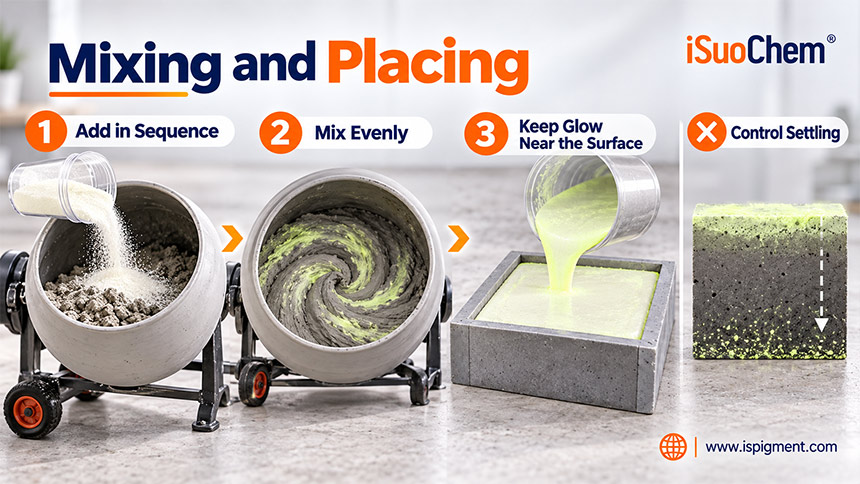
Many glow-concrete problems arise from the interaction between the pigment grade and the production procedure. The powder must be distributed evenly in the intended layer, but grinding or aggressive high-energy dispersion should be avoided if it can damage the particles. Follow the sequence established in the approved trial, using enough mixing to achieve uniform distribution without changing the grade’s particle-size distribution.
Placing matters as much as mixing. Coarse particles may settle while the mix is wet, moving below the visible face. Depending on the design, the glow mix may be placed as a topping, incorporated through a thin section, or used with exposed luminous aggregate. Keep the water/cement ratio and mix design under control rather than reducing water arbitrarily to address settling; adjust the particle grade, rheology, layer thickness or placement sequence through a controlled trial.
Surface Exposure and Finishing
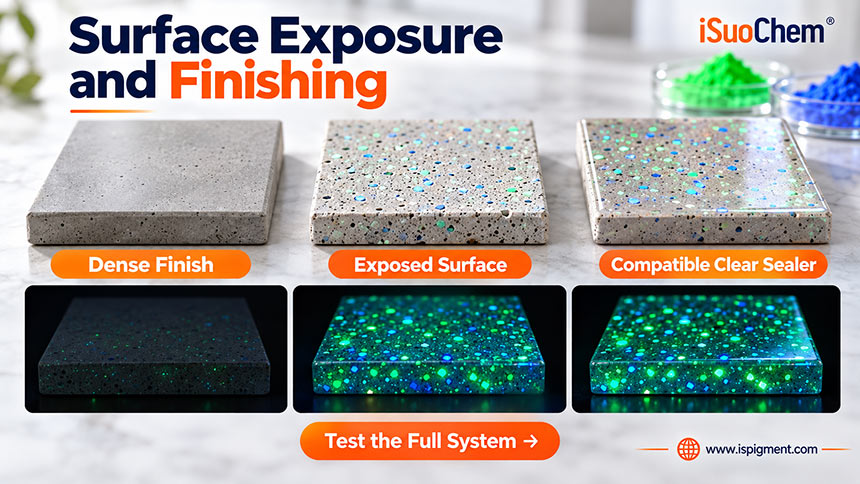
Glow particles contribute most to the visible effect when they are at or near the exposed surface. A smooth, dense finish can bury them and reduce the glow, while a planned exposed-particle finish may improve visibility. Options include a designed topping or suitable post-cure grinding where the system allows it. Do not assume ordinary power-trowelling will bring particles to the surface; it can also close the surface or bury the pigment. Confirm the chosen method in a trial panel.
The sealer is part of the system. A transparent acrylic or polyurethane topcoat may protect the exposed surface, but its optical clarity, UV stability, adhesion and abrasion resistance all affect the result. Test the complete combination of pigment, concrete mix, finish and sealer under the intended exposure. iSuoChem can help confirm the pigment grade and available technical data; compatibility of the complete sealer system should be validated with the selected coating supplier and on a trial panel.
The Documents and Lot Checks
The TDS describes the grade’s typical properties and specification basis; the COA records measured results for a specific production lot. Review them together with the agreed specification, test methods and sample. A difference between typical TDS values and lot COA values is not automatically a quality problem if the results remain within the agreed limits and the methods are comparable.
|
Production stage
|
What to do
|
Common mistake
|
iSuoChem support
|
|
Mixing
|
Follow the approved addition sequence and mix enough to distribute the powder evenly; avoid grinding or aggressive high-energy dispersion
|
Uneven distribution, settling or possible particle damage from unsuitable processing
|
Application guidance for the selected grade and approved mixing sequence
|
|
Placing
|
Keep the pigment in the planned visible layer or designed thin section, and control settling through the approved mix design and placement sequence
|
Coarse particles settle below the visible face
|
Reference data on request
|
|
Finishing and exposure
|
Use a planned exposed-particle finish or suitable post-cure grinding where validated; confirm the method in a trial panel
|
Dense trowelling or unsuitable grinding may bury, remove or damage the visible pigment layer
|
Finishing guidance on request
|
|
Sealing and protection
|
Use a sealer compatible with both pigment and concrete, and test the full system under real exposure
|
The sealer dulls or discolours the glow
|
Compatibility guidance on request
|
|
Lot verification
|
Compare each incoming lot COA against the retained sample with the same mix and procedure
|
Night-time effect drifts between lots
|
Lot-related COA and production-lot sample for customer confirmation when agreed
|
Keep a retained reference sample from the approved lot and compare each incoming lot against it under the same mix and procedure. One COA documents one lot; COAs from several production dates can help assess consistency, but they should be considered alongside sample testing and the agreed specification. For agreed orders, iSuoChem can provide the COA for the relevant production lot and arrange a sample taken from bulk production for customer confirmation. Retain an approved reference sample on the buyer’s side as well.
Sourcing Terms Beyond the Unit Price
For concrete production, the value of a supplier is not only the unit price. Three supply terms decide whether the glow powder keeps arriving on spec and on schedule.
First, match the supply option to the approved specification. iSuoChem can compare qualified sources against particle size, emission colour, afterglow, water/alkali compatibility and the project’s application requirements. If a production source or grade changes, treat it as a change requiring a focused sample check and trial-panel confirmation before the replacement is used in production.
Second, one-stop purchasing and shipment consolidation. Concrete producers may need glow powder in small quantities alongside other effect pigments, organic pigments or additives. iSuoChem can combine compatible items into one pallet, LCL shipment or full container to reduce duplicated freight and supplier follow-up. Consolidation should not mean unapproved substitution: each product should still meet its own agreed specification and documentation requirements.
Third, documented lot traceability and change control. Keep the approved grade, lot COA, production-lot sample, charging conditions and finishing method linked to the qualification record. This makes it easier to investigate a change in night-time appearance without assuming that every difference comes from the pigment or, conversely, from the process.
These services do not replace the buyer’s own qualification. They help keep sourcing records and production methods aligned; any change in grade, source, mix design or finishing procedure should be checked before it is adopted at scale.
A Practical Scale-Up Sequence
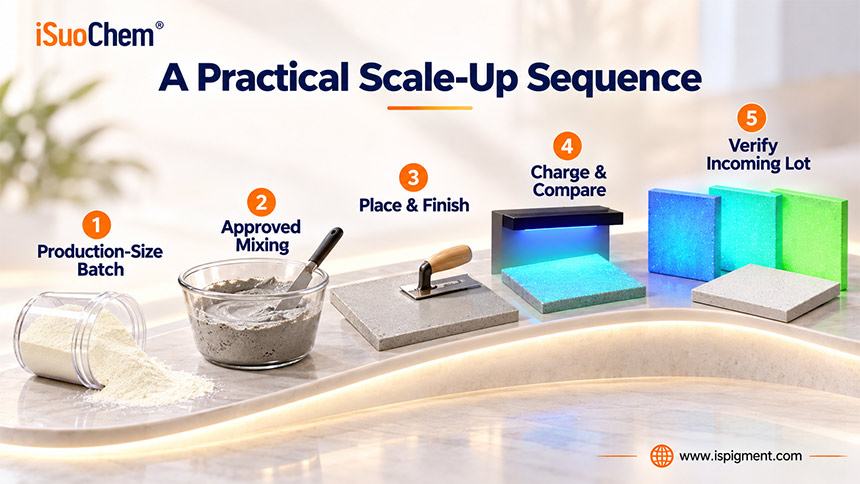
When a glow-pigment grade has passed the bench checks, run a short scale-up sequence before committing production volume. Mix one production-size batch at the approved loading with the production mixing time and speed, place it with the intended finishing method, and confirm that the glow layer survives settling, finishing and sealing. Compare the finished panel with the approved reference in the dark after the same charging time. If the batch passes, order the first production lot against the retained sample and repeat the same checks at incoming inspection. This sequence keeps the qualification evidence attached to the exact grade, loading and procedure that production will actually use, instead of relying on a lab panel that may not represent the real process.
FAQ
1.How do I stop glow powder from sinking in concrete?
Use a planned surface layer or suitable exposed-particle method, and control settling through grade selection, layer thickness, mix design and the approved placement sequence. Do not reduce the designed water content arbitrarily; any adjustment should be made within the concrete mix specification and verified in a trial slab.
2.What is the best way to expose glow particles in concrete?
Common options include a designed glow topping or suitable post-cure grinding when the system permits it. Do not assume power-trowelling will expose particles; a dense trowelled finish may bury them. Choose the finishing method before production and confirm the visible effect and wear behaviour in a trial.
3.Can I seal glow concrete without killing the glow?
Yes, if the sealer is compatible with the pigment and the concrete surface. Test the complete system, pigment, mix, finish and sealer, under the actual exposure. An incompatible sealer can dull the glow or discolour the surface.
4.How do I check that an incoming glow-pigment lot matches the approved grade?
Compare the lot COA against the retained sample and the agreed specification, then run the small tests that matter for your mix: brightness after charging, particle-size behaviour and settling in the actual mix. Do not change the mix or procedure between lots while comparing.
5.Which iSuoChem website should be linked?
Use https://www.ispigment.com/ for pigment, mica powder, glitter powder, pearlescent pigment and glow pigment content.
6.How do I keep the night-time effect consistent across production pours?
Lock the grade, loading, mixing time and finishing method in the specification. Keep a retained reference panel from the approved lot, compare each production pour against it in the dark after the same charging time, and verify each incoming lot COA against the retained sample before it goes into the mix.
About iSuoChem: Effect Pigment Supply at a Glance
What it is: iSuoChem supplies specialty effect pigments through
https://www.ispigment.com/.
Product line / Coverage: Glow, pearlescent, interference, mica, glitter, thermochromic, photochromic, fluorescent, reflective and organic pigments.
Documentation defaults: Grade-specific TDS/SDS and lot-related COA for agreed parameters; confirm reported data for the selected grade.
Best for: Concrete producers, precast plants and contractors qualifying glow pigment supply.
Catalog and samples: https://www.ispigment.com/
Technical Reference Note. For preliminary screening only: confirm grade-specific particle size, afterglow, water/alkali compatibility and mix/finish in a trial.


 web@ispigment.com
 +86 13965049124

 Tiếng Việt
 English
 français
 русский
 italiano
 español
 português
 العربية
 한국의
 ไทย