theo chúng tôi


theo chúng tôi
gần đây bài viết
Fluorescent pigment can build up on an extrusion screw or injection-molding barrel when the pigment system becomes insufficiently compatible with the surrounding polymer, or when its resin matrix, carrier, additives, or the base polymer experiences excessive thermal or thermo-mechanical stress. The problem is therefore not simply a matter of “temperature being too high.” Daylight fluorescent pigments commonly contain a fluorescent dye associated with a synthetic resin matrix, and the chemistry of that matrix can influence heat resistance, compatibility, dispersion, and plate-out behavior.[1]
In plastic processing, screw build-up should be treated as a material–process interaction. The main variables are fluorescent pigment structure, pigment-binder/base-resin compatibility, masterbatch carrier, wetting and dispersion, actual melt temperature, screw speed, shear, residence time, and process stability. Research on extrusion shows that machine setpoints do not necessarily equal the melt temperature actually experienced by the material, while screw speed and residence history can change the thermal and mechanical load.[2]
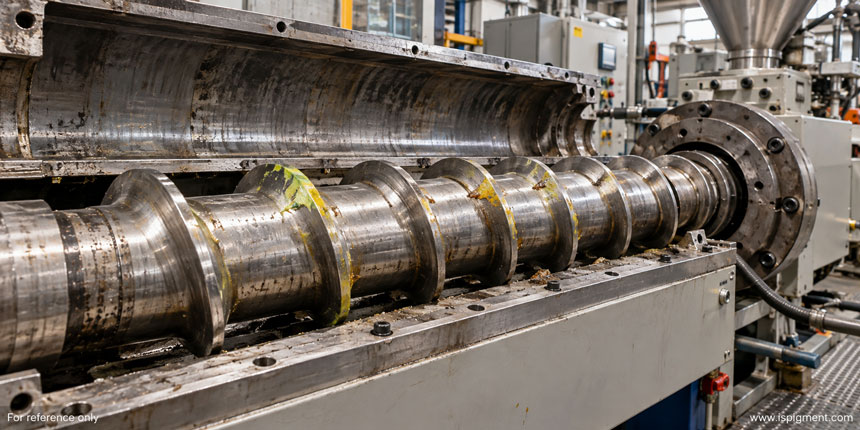
A fluorescent pigment should not be treated as a simple insoluble color particle. In many daylight fluorescent systems, the fluorescent dye is incorporated into a solid resin matrix. Analytical research on commercial daylight fluorescent pigments has identified synthetic resin carriers and shown that their chemistry can vary between products.
This distinction matters because the material that eventually deposits on a screw may not be the fluorescent dye alone. Depending on the formulation and processing history, the deposit can contain material associated with the fluorescent pigment resin matrix, a masterbatch carrier, additives, degraded base polymer, or a combination of these components.
It is also important to distinguish two different meanings of “carrier”:
|
Component |
Role |
Processing significance |
|
Fluorescent pigment resin matrix / binder |
Holds or immobilizes the fluorescent dye in the pigment particle |
Influences thermal behavior and compatibility |
|
Masterbatch carrier resin |
Delivers the pigment into the base polymer |
Influences wetting, flow and dispersion |
|
Base polymer |
Main PE, PP, ABS, PVC or other thermoplastic |
Determines the melt environment and processing window |
This is why a fluorescent pigment that gives excellent color in one plastic system may not process identically in another. The pigment grade, carrier, polymer and processing conditions all interact.
A separate iSuoChem article already explains what fluorescent pigments are and how fluorescence works. The present article addresses a narrower production problem: why fluorescent pigment can create screw build-up and how processors can identify the actual cause.
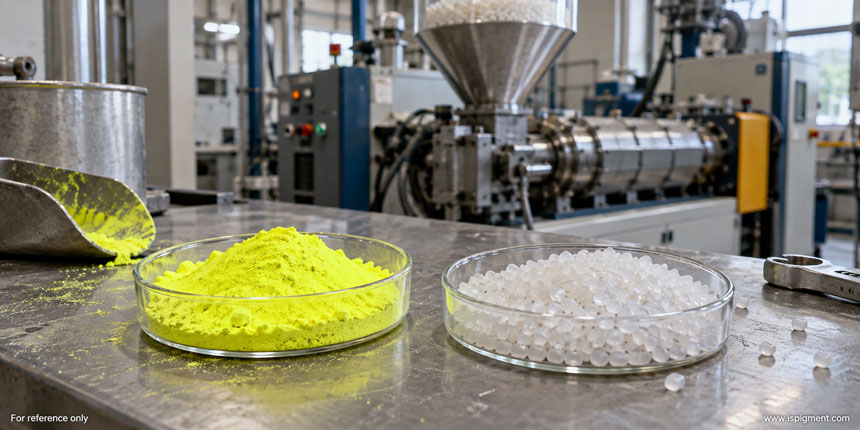
Screw build-up usually results from several interacting mechanisms rather than one universal failure mode.
Heat is an important risk factor, but “high temperature” should not be used as a complete explanation.
Fluorescent pigment grades can have different resin systems and different processing windows. A technical patent on low-plate-out fluorescent pigment concentrates describes fluorescent pigment plate-out as separation from the base plastic by deposition on screws and other metal processing equipment. It specifically links the problem to incompatibility between the fluorescent pigment binder and the plastic base and also identifies limited heat resistance and high-shear processing as relevant constraints.[3]
The engineering point is that temperature must be considered together with time and material grade.
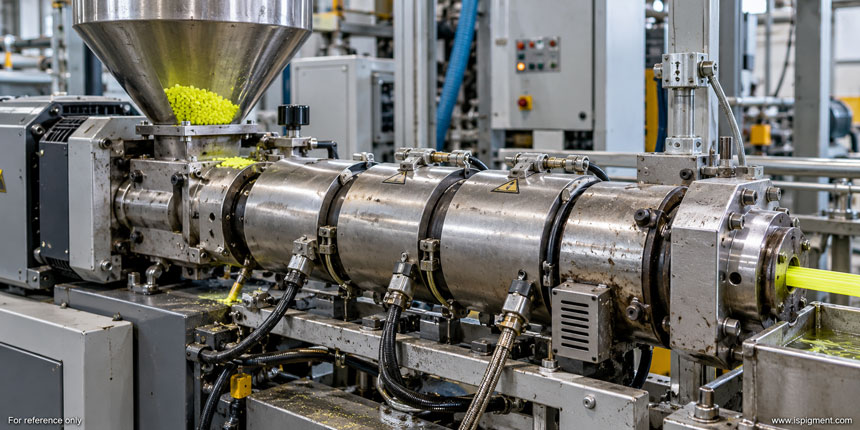
A short exposure at a temperature a pigment can tolerate may cause little trouble, while prolonged residence, repeated thermal cycling or a local hot spot can increase the risk of degradation or accumulation. Conversely, lowering the barrel temperature alone may not solve a compatibility or dispersion problem.
Extrusion research also shows why equipment settings should not be treated as direct measurements of material exposure. In a single-screw extruder study, actual melt temperature was found to differ significantly from equipment set temperatures, and increasing screw speed increased melt temperature.
Therefore, the relevant question is not simply:
“What temperature is the barrel set to?”
It is:
“What temperature does the pigment-containing melt actually experience, for how long, and under what shear conditions?”
Compatibility is one of the most important factors to investigate.
The fluorescent pigment has its own resin-associated chemistry, while the base plastic may be PE, PP, ABS, PVC, EVA or another polymer. If the pigment binder has insufficient affinity for the surrounding polymer melt, phase separation or migration toward metal surfaces can become more likely.
The direct fluorescent-pigment patent literature describes this mechanism explicitly: incompatible fluorescent pigment binder and plastic base can cause phase separation and plate-out on screws and other metal processing equipment.
This also explains why heat resistance alone is not enough. Two pigments may have similar color strength and nominal thermal limits but behave differently in the same extrusion line because their resin matrices, surface characteristics or additive systems differ.
|
Situation |
Thermal stability |
Compatibility risk |
First investigation |
|
Suitable pigment + compatible resin |
Appropriate for process |
Lower |
Maintain process control |
|
Suitable pigment + poorly matched resin |
May remain thermally stable |
Higher |
Check pigment-binder/base-resin compatibility |
|
Heat-sensitive pigment + compatible resin |
Narrower processing window |
Moderate |
Reduce thermal exposure or select another grade |
|
Heat-sensitive pigment + poorly matched resin |
Multiple risks interact |
High |
Review grade and formulation together |
When fluorescent pigment is introduced through a masterbatch, the carrier becomes a second important compatibility variable.
A masterbatch contains pigment, carrier and additives. The carrier should provide suitable wetting and flow so that the pigment can be distributed through the base polymer. In practical formulation work, carrier selection should therefore be evaluated in relation to the target polymer rather than treated as an independent component.
Research on pigment masterbatches has shown that formulation and process parameters can significantly affect pigment dispersion. In a recent polyethylene masterbatch study, wax properties, screw speed, barrel temperature and mixing time were evaluated, with wax properties and screw speed among the most influential factors on dispersion.[4]
This does not mean poor carrier compatibility automatically causes screw build-up. Rather, an unsuitable carrier can promote poor wetting, phase separation or unstable dispersion, which may increase the likelihood of deposits under certain processing conditions.
If screw build-up starts after changing the masterbatch supplier, carrier system or pigment concentration, the masterbatch should therefore be investigated rather than assuming that the fluorescent pigment itself is defective.
Poor dispersion is another possible contributor, but it should not be treated as proof of screw sticking.
Pigment agglomerates must be sufficiently wetted and broken down by the polymer melt. Research on thermoplastic pigment compounding shows that processing conditions and formulation factors influence dispersion, while masterbatch studies have linked process parameters with agglomeration and color strength.
However:
Poor dispersion → possible contributing factor
does not mean:
Poor dispersion → definite cause of screw build-up.
If large agglomerates, uneven color, filter-pressure changes and deposits appear together, the dispersion system deserves attention. But the root cause may still be incompatibility, thermal exposure, carrier behavior or another processing problem.
Shear is necessary for dispersion, butmore shear is not always better.
Increasing screw speed can improve mixing in some systems, but it can also increase the melt temperature and thermo-mechanical load. Research on single-screw extrusion found that screw speed affected melt temperature, while other research on polymer extrusion demonstrated that processing temperature and mechanical stresses can influence degradation behavior.
The practical balance is:
|
Shear condition |
Potential benefit |
Potential risk |
|
Too little shear |
Lower mechanical load |
Incomplete wetting and dispersion |
|
Appropriate shear |
Effective distribution |
Balanced process load |
|
Excessive shear |
Faster mixing in some systems |
Higher melt temperature or thermo-mechanical stress |
The objective is therefore not maximum shear. It is sufficient dispersion with controlled thermal and mechanical exposure.
Residence time is another variable that can be overlooked.
Different portions of material can experience different residence times and thermal histories inside an extruder. Research using residence-time-distribution measurements in a single-screw extruder showed that screw speed and temperature affect how long material remains in the machine, and that low screw speed increases the time delay through the extruder.
For fluorescent pigment processing, prolonged residence can increase the opportunity for thermal exposure, accumulation or degradation, particularly when the line is unstable.
Pay particular attention to:
unusually low throughput;
long machine idle periods;
frequent stops and starts;
unstable feeding;
dead zones;
material remaining in a hot barrel during interruptions.
If deposits appear mainly after production interruptions rather than during stable continuous production, residence history deserves priority in the investigation.
This distinction is important because it is easy to misuse pigment specifications.
Softening point, decomposition temperature and recommended processing temperature are different properties. A softening point describes a material transition measured under a defined test method. A processing-temperature recommendation describes the performance of a particular pigment system under specified processing conditions.
Therefore:
Softening point ≠ decomposition temperature ≠ recommended processing temperature.
This does not mean softening point is irrelevant. It means it should not be used alone to calculate a safe extrusion or injection-molding temperature.
The more useful purchasing and technical questions are:
What is the recommended processing temperature range?
What plastic types have been tested?
Is the grade intended for extrusion, injection molding or both?
What is the recommended pigment loading?
Is it designed for direct addition or masterbatch use?
What dispersion conditions are recommended?
How was plate-out or heat stability evaluated?
Published fluorescent-pigment testing illustrates why grade-specific data matter. In one industry comparison, two fluorescent pigment families showed markedly different plate-out behavior during injection molding of PE-HD: one developed increasing plate-out over 300 molded chips, while the other showed no plate-out under the reported test conditions.[5] The same comparison also reported different heat-stability behavior.
These results should not be generalized to every fluorescent pigment, but they demonstrate an important principle:
Fluorescent pigment processing behavior is grade-specific.
When colored residue is found on a screw or barrel, it is tempting to say that “the fluorescent pigment has burned onto the screw.” That may be an oversimplification.
The deposit may contain:
material from the fluorescent pigment resin matrix;
fluorescent pigment-associated components;
masterbatch carrier resin;
dispersants, waxes or other additives;
degraded base polymer;
residues from previous production.
Research on plastic-processing equipment has shown that deposits can form at the interface between polymer melt and steel surfaces, particularly on screws, barrels and tools. One study identified chemical and interfacial interactions between polymer melt and tool steel as part of a proposed deposit-formation mechanism.
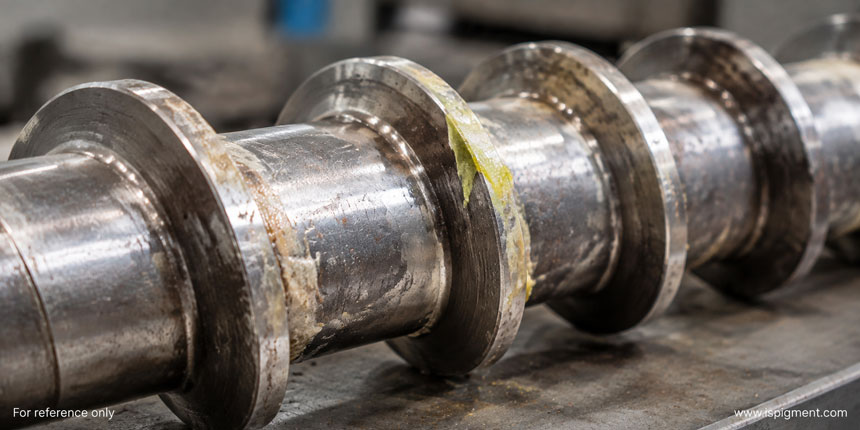
This does not mean that every fluorescent-pigment deposit contains metal–polymer reaction products. The study used polycarbonate as its main model system, not fluorescent pigment. Its value here is narrower: it demonstrates that screw and barrel deposits are not necessarily explained by pigment degradation alone.
A useful diagnostic question is therefore:
What is the deposit actually made of?
If the problem is persistent, comparing the residue with the original pigment and masterbatch by microscopy, FTIR or another appropriate analytical method can help distinguish pigment-rich deposits from polymer-, carrier- or additive-rich residues.
A troubleshooting process should begin with production symptoms rather than immediately changing temperature.
|
Production symptom |
Possible indication |
First check |
|
Build-up begins after changing pigment grade |
Pigment chemistry or compatibility |
Compare pigment grades and binder systems |
|
Build-up begins after changing masterbatch |
Carrier or additive effect |
Compare carrier and formulation |
|
Deposits increase with screw speed |
Higher melt temperature or thermo-mechanical load |
Measure actual melt temperature |
|
Poor dispersion appears together with deposits |
Wetting or masterbatch issue |
Check agglomeration and carrier compatibility |
|
Problem occurs only in one base resin |
Resin compatibility |
Compare pigment behavior across polymers |
|
Deposits appear mainly after machine stops |
Residence/thermal history |
Check idle time and hot-barrel exposure |
|
Deposits accumulate gradually during long runs |
Plate-out/accumulation mechanism |
Compare short and extended production runs |
|
Dark specks appear with deposits |
Polymer degradation or contamination may also be involved |
Check dead zones, purge material and residue composition |
This matrix is not a diagnostic algorithm that proves a single cause. It is a way to prioritize the next experiment.
For persistent problems, change one major variable at a time. For example, keep the base resin and machine settings constant while comparing two fluorescent pigment grades. Then keep the pigment constant and compare two masterbatch carriers. This provides much stronger evidence than changing pigment, temperature, screw speed and loading simultaneously.
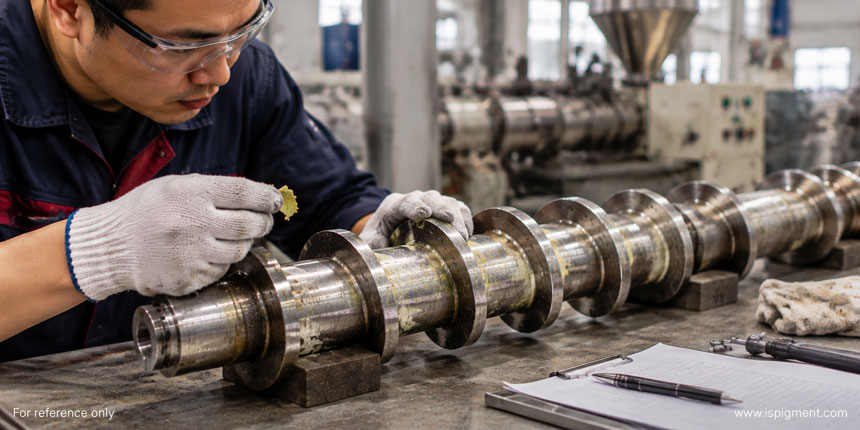
Processing parameters interact with one another, so the following table should be read as a troubleshooting guide rather than a set of universal rules.
|
Process variable |
If increased |
What to monitor |
|
Barrel temperature |
Usually increases thermal exposure and may reduce melt viscosity |
Actual melt temperature and pigment stability |
|
Screw speed |
Can improve mixing but may increase melt temperature |
Dispersion versus thermo-mechanical load |
|
Feed rate |
Changes filling, throughput and residence behavior |
Output stability and residence history |
|
Residence time |
Increases time available for thermal exposure |
Deposits, discoloration and process stability |
|
Shear |
Can improve de-agglomeration |
Local heating and pigment stability |
|
Pigment/masterbatch loading |
Raises local colorant concentration |
Dispersion and plate-out tendency |
The important point is that no single setting can be evaluated independently.
For example, lowering screw speed may reduce mechanical input but increase residence time. Lowering barrel temperature may reduce thermal exposure but may also impair melting or dispersion. Increasing screw speed may improve dispersion but increase melt temperature.
The correct process window is therefore a balance, not a single “safe temperature” number.
Choose fluorescent pigment according to the complete application:
base polymer;
extrusion or injection molding;
actual melt-temperature range;
pigment loading;
residence time;
expected shear;
direct pigment addition or masterbatch.
A grade developed for one plastic system should not automatically be assumed to behave identically in another.
When masterbatch is used, evaluate the carrier and additives together with the pigment.
Check carrier type, melt behavior, pigment concentration, dispersant/lubricant package and compatibility with the base polymer. Published masterbatch research confirms that formulation and process parameters can materially affect pigment dispersion.
Barrel setpoints are useful process controls, but they are not necessarily the temperature experienced by the pigment-containing melt. Extrusion research has demonstrated that actual melt temperature can differ from equipment settings and can increase with screw speed.
Where practical, measure the melt temperature and compare it with the supplier's recommended processing range.
Also investigate possible local hot spots around adapters, dies, nozzles or stagnant regions.
Avoid leaving pigment-loaded material at elevated temperature for unnecessarily long periods.
If a line frequently stops, check whether pigment-containing resin remains in the hot barrel. Production stability can be as important as nominal temperature.
Use enough shear to obtain acceptable dispersion, but do not assume that higher screw speed is automatically better.
If dispersion is poor, first investigate pigment/carrier compatibility and formulation before simply increasing mechanical input.
For a persistent screw build-up problem, a controlled comparison can be more informative than repeated process adjustments.
|
Trial |
Pigment |
Carrier |
Base resin |
Process |
Main purpose |
|
A |
Current |
Current |
Current |
Current |
Baseline |
|
B |
Alternative grade |
Current |
Current |
Current |
Test pigment effect |
|
C |
Current |
Alternative |
Current |
Current |
Test carrier effect |
|
D |
Current |
Current |
Current |
Lower thermal exposure |
Test temperature contribution |
|
E |
Current |
Current |
Current |
Adjust screw speed/feed |
Test thermo-mechanical history |
Whenever possible, change only one major variable between trials.
Fluorescent pigment screw build-up should not be reduced to the statement that “the pigment is not heat resistant.”
A more useful explanation is amaterial–process interaction.
The fluorescent pigment resin matrix can influence thermal and interfacial behavior. The masterbatch carrier can influence wetting and compatibility. The base polymer determines the melt environment. Dispersion determines how uniformly the pigment is distributed. Screw speed, shear, actual melt temperature and residence time determine the thermo-mechanical history.
Published fluorescent-pigment evidence also shows that different grades can have substantially different plate-out and heat-stability behavior under comparable plastics-processing tests.
For B2B plastic manufacturers, the key lesson is simple:
Select fluorescent pigment by the complete processing system—not by color and nominal heat-resistance data alone.
thẻ :
bản quyền © 2026 iSuoChem.Đã đăng ký Bản quyền.
đội ngũ chuyên nghiệp để phục vụ !
 web@ispigment.com
 +86 13965049124

 Tiếng Việt
 English
 français
 русский
 italiano
 español
 português
 العربية
 한국의
 ไทย


